
What is behind "a simulation will tell us"
When people consider building or renovating a cleanroom, we often hear, "We would like to run an airflow simulation." From the outside, though, it is hard to see what a simulation can and cannot tell you, or how much time and effort it takes. This article explains what is involved, for readers who are thinking about requesting one.
Think of the analysis in two stages
A cleanroom analysis is easier to plan when it is split into two stages.
The first is the balance for the room as a whole. How many particles are generated in the room, and how many are removed by ventilation and filtration? This balance determines the air change rate and the number of air purification units needed to hold the target cleanliness class. In an earlier article, we noted that simply adopting the upper end of the recommended air change rate tends to produce an overspecified design. This first stage is the foundation for revisiting that choice.
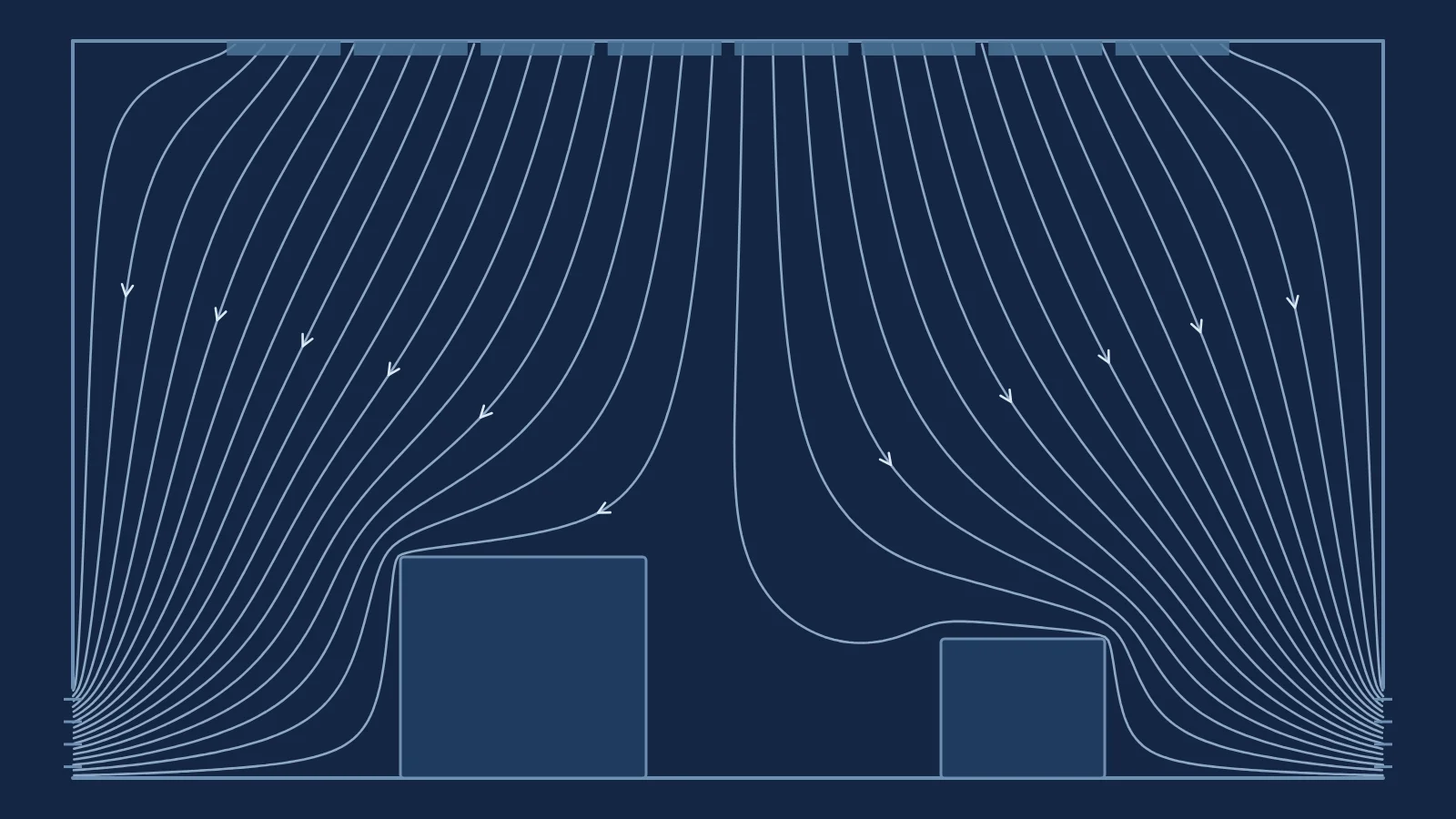
The second is the distribution inside the room. Even when the room as a whole meets its cleanliness class, the particle concentration differs from place to place. Here we use airflow simulation (CFD, computational fluid dynamics) to see where the air flows and where it stagnates.
Rather than starting directly with a detailed calculation of the second stage, it is less wasteful in both cost and time to get an overall estimate from the first stage and then look in detail at the locations that matter.
What an airflow simulation can tell you
- Where air stagnates: places such as behind equipment or in the corners of the room, where the air is slow to be replaced and particles tend to accumulate
- Short-circuiting: clean air from the supply outlets that flows straight to the return grilles without passing through the work zone
- The effect of layout: how the concentration in the work zone changes when supply outlets, return grilles, equipment, or purification units are moved
- Comparisons between conditions: how far cleanliness holds up when the air change rate or the number of purification units is changed
The last of these is hard to try in a real room. Being able to line up several options under the same conditions before construction begins is the greatest advantage of simulation.
What it cannot tell you, and what needs care
Simulation also has limits.
- The estimate of particle generation: what affects the result most is the estimate of how many particles come from people's movements and from equipment. If that estimate does not match reality, no amount of computational detail will make the result match
- Events that change over time: brief disturbances, such as doors opening or people entering and leaving, are averaged out in an ordinary steady-state calculation. When they matter, they are evaluated in a different way
- The accuracy of the calculation itself: depending on how the computational mesh is built, making it finer does not always make the result more accurate (see "In CFD, a Finer Mesh Doesn't Always Mean Higher Accuracy")
For that reason, if you have measured data, such as particle counter readings, we compare it with the calculated results. It is also possible to measure again after an improvement has been made, check whether the result matches what the calculation predicted, and bring the model closer to the actual room. A process that repeats measurement and calculation in this way is best suited to an ongoing engagement.
What to prepare before requesting an analysis
You do not need to have everything. Whatever you can provide is enough, and we will work through anything missing together in the first conversation.
- Floor plans and sections of the room
- The locations and airflow rates of the supply outlets (such as FFUs) and return grilles
- The layout and size of the main equipment, and its heat output if any
- The number of people working in the room and their main tasks
- The target cleanliness class
- For an existing room, particle counter measurements
How an engagement usually runs
A cleanroom analysis usually proceeds through some of the following steps.
- Initial conversation: we hear what you are facing and what materials you have, and work out which stage of analysis is needed
- Trial analysis: a simple analysis of one room under its current conditions, summarized in a short report of two or three pages
- Second opinion: a review of whether the air change rate or equipment count proposed by a contractor, or an analysis you already have, is reasonable
- Single analysis: a comparison of around five conditions that vary the air change rate and the number and placement of purification units, through to recommendations for improvement
- Ongoing support: continuous involvement, from design review at the planning stage of a new facility to comparing measurements and calculations before and after improvements
We provide a quotation once the scope is clear. Meetings are held online, so we can work with clients wherever they are.
How to start a conversation
"We are not sure we even need a simulation." "We want to know whether the air change rate in this quotation is reasonable." Inquiries at that stage are very welcome. Please take a look at our cleanroom airflow analysis service, and feel free to get in touch.