
The assumption that a finer mesh means better accuracy
When a CFD (computational fluid dynamics) result looks less accurate than expected, the first fix most teams reach for is refining the mesh, the computational grid. Most of the time, that works. But this assumption doesn't always hold.
What actually happened: refining the mesh 8x didn't close the gap
We solved laminar pipe flow (Reynolds number around 10, a case with a known analytical solution) in OpenFOAM. We started with an unstructured tetrahedral mesh, a mesh-generation approach that adapts automatically to the geometry and is easy to work with. With roughly 29,000 elements, velocity error against the analytical solution was a healthy 0.5%, but pressure-drop error sat at 17.5%.
We then refined the mesh 8x, to roughly 223,000 elements, and solved again. Velocity error improved further, but pressure-drop error actually got worse, rising to 19.5%. Normally, a finer mesh should shrink the error. Getting worse, not better, with refinement was the signal that something other than plain under-resolution was at play.
The cause: a poorly shaped mesh
Checking mesh quality revealed the real issue: non-orthogonality, a measure of how skewed the connections between neighboring cells are, wasn't improving with refinement, and in fact got slightly worse. This is a property of the tetrahedral cell shape itself, not something simple subdivision fixes. In the finite volume method, pressure is far more sensitive to this kind of grid skew than velocity is, which is exactly why only the pressure error stood out.
The fix: switching to a structured mesh
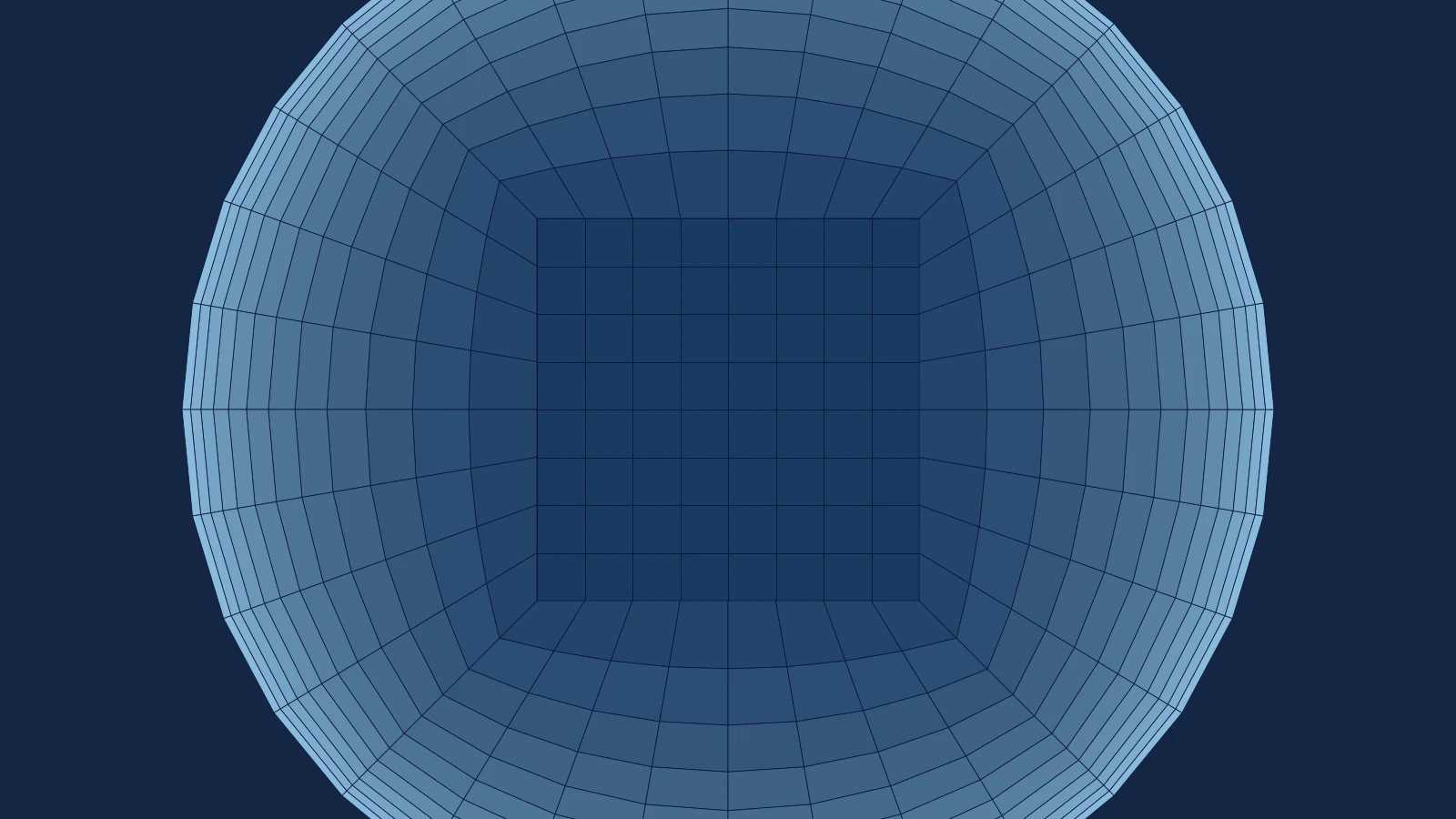
We rebuilt the mesh as a structured grid: the pipe's circular cross-section split into a central square block surrounded by four curved sector blocks, with cells arranged in a regular pattern. Solving the same case again, the non-orthogonality metric improved dramatically, and pressure-drop error dropped to 2.3%, roughly an eighth of the error from the unstructured mesh.
The habit of always verifying
The lesson here is that the intuitive fix, refine the mesh, isn't always the right one. What matters more is checking results against an analytical solution or known measurement every time, and when they don't match, tracing the discrepancy down to its root cause, which in this case turned out to be mesh shape. At Mathematical Physics Labo, this kind of verification process is not an afterthought; it's the core of how we do analysis.
How to start a conversation
"I'm not sure how much I can trust this simulation result." "I'd like a second opinion on an analysis we outsourced." Inquiries at that stage are very welcome. Mathematical Physics Labo delivers analysis results built on a rigorous verification process.