
Why "without cutting it open" matters
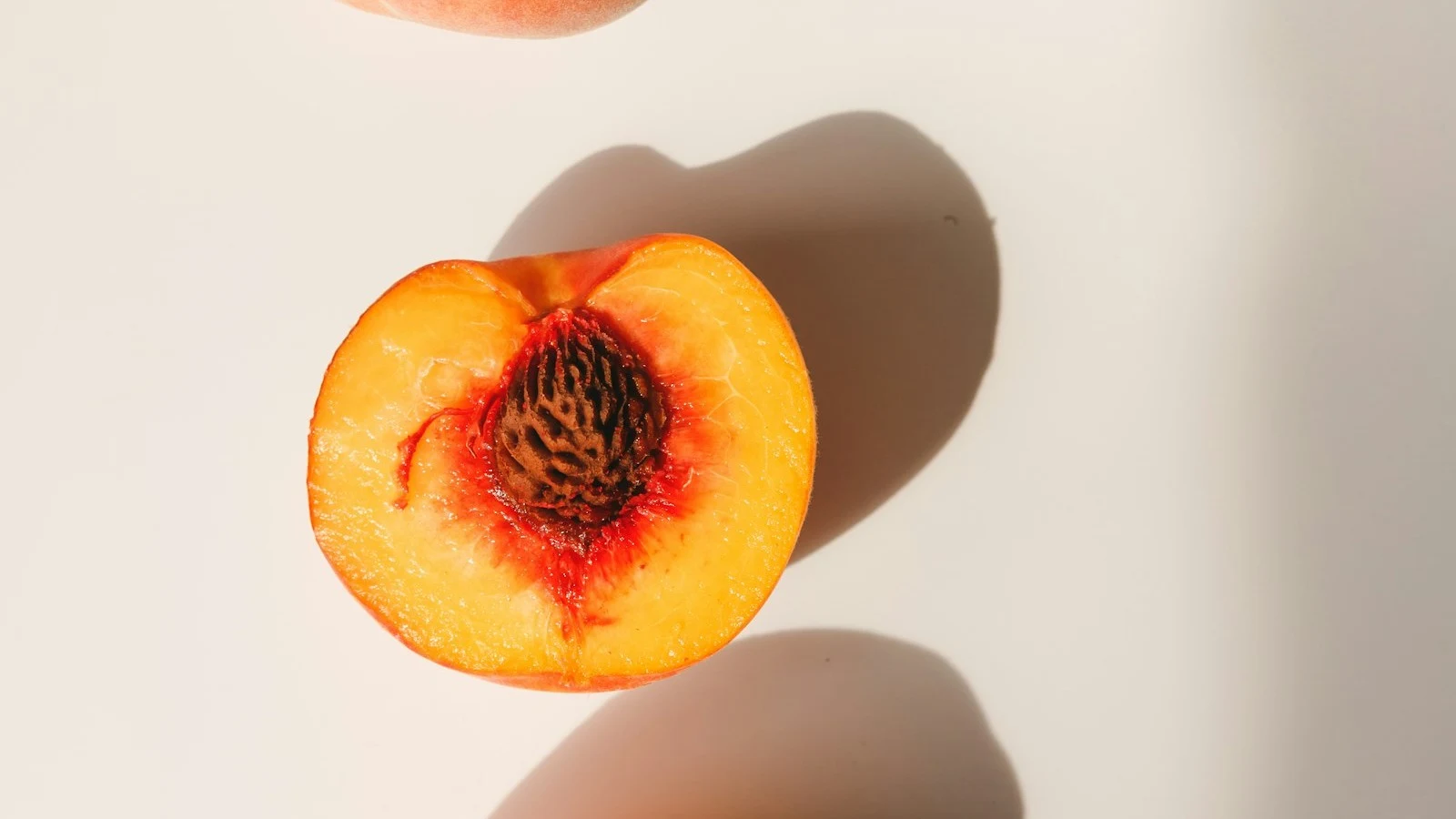
Split pit, a physiological disorder in which a peach's stone cracks internally, is nearly impossible to detect from the outside. Split-pit fruit also tends to taste worse — less sweet, with a pronounced astringency — a quality concern growers notice directly. Left undetected, it undermines market reliability further downstream as well: in processed products it shows up as inconsistent quality, and stone fragments raise the risk of foreign-object contamination. Cutting the fruit open would confirm it, but at that point it can no longer be sold. Knowing the internal condition without breaking it open is exactly what an acoustic vibration method achieves.
How sound reveals what's inside
An acoustic vibration method applies vibration to an object and measures its response, the resonant frequencies it produces, to estimate internal properties. In fruit research, the second resonant frequency (f2) had already been used to evaluate firmness and ripeness. Measurements for this research were taken with a portable resonant-frequency device developed by Applied Vibro-Acoustics, Inc.
The insight: the ratio of f3 to f2
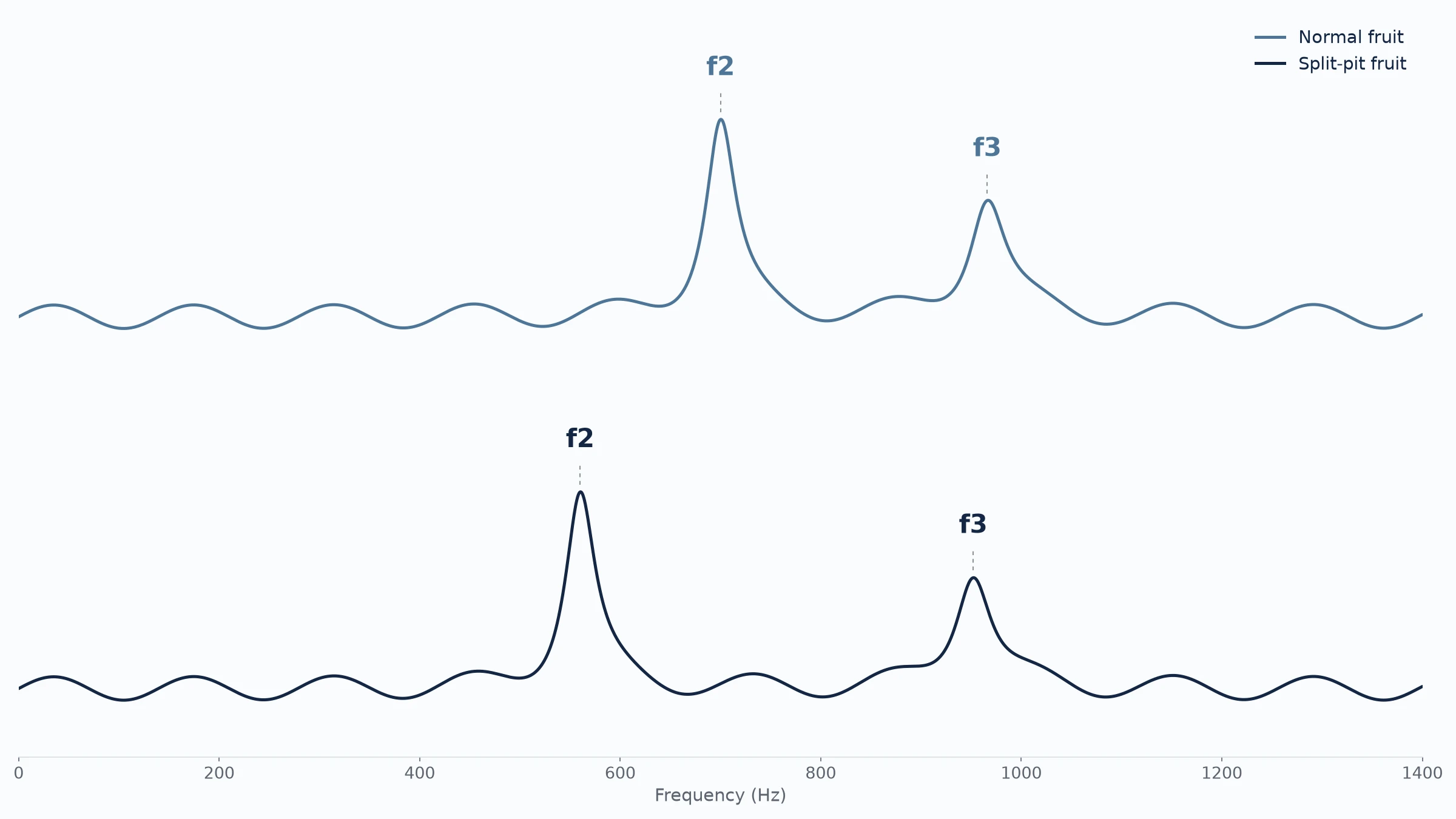
What made this approach to detecting split pit distinctive was looking not at a single resonant frequency, but at the ratio of the third (f3) to the second (f2) resonant frequency.
Across more than 300 peaches, the f3/f2 ratio in normal fruit fell within a narrow range of 1.35 to 1.4. In split-pit fruit, the ratio rose to 1.45–2.0.
Setting the cutoff at 1.45 correctly identified 95% of split-pit fruit, while misclassifying only 1.5% of normal fruit. That level of accuracy is enough to build into a commercial sorting line as a simple, low-cost inspection method.
Confirming the mechanism with finite element analysis
The finding was not based on measurement alone. A finite element model, built in ANSYS, reproduced the same effect: modeling the peach as a sphere and inserting a gap representing a split pit produced the same rise in the f3/f2 ratio seen in the actual measurements.
The academic value of this work lies not simply in finding an indicator that "works," but in confirming with a physical model why that indicator reflects split pit.
Japanese Society for Horticultural Science best paper award
The results were published in 2018 in The Horticulture Journal (Nakano et al., 2018. Horticulture Journal 87: 281–287) and received the Japanese Society for Horticultural Science's Annual Best Paper Award. The director of Mathematical Physics Labo (MPL) was affiliated with Hiroshima University at the time and took part in the research as one of its authors. The work was carried out as a joint project between Okayama University and Hiroshima University, in the laboratory of Naoki Sakurai, now of Applied Vibro-Acoustics, Inc.
Bringing particle-physics methods to agriculture
Why the f3/f2 ratio responds so sensitively to split pit is a question we continue to investigate theoretically, through a more fundamental approach: modeling the fruit as a viscoelastic body and explaining the phenomenon through the phase lag in its response to forced vibration.
The commitment to understanding why something works from first principles, rather than using it simply because it works, carries directly over from particle physics research conducted at Fermilab and SLAC. Whether the subject is a subatomic particle or a piece of fruit, the underlying work, uncovering the physical law behind a phenomenon, does not change.
How to start a conversation
If you need to determine an internal condition without destroying the object, or you are looking for a method grounded in physical evidence rather than a rule of thumb, please get in touch. At Mathematical Physics Labo, inquiries on non-destructive testing and vibration analysis are handled with theory that carries a track record in peer-reviewed research.